
UN dues credit return, UNITAR & UNSSC merger, SG Race, UN Tax Convention and more

No. 18 | Mid-year Recap
Global Policy Forum (GPF) distributes Global Policy UN Watch (GPUNW) to alert CSOs and other actors of recent and potentially useful developments at United Nations headquarters. The GPUNW provides a snapshot of on-going and upcoming policy deliberations and diverse governmental and official UN positions, and complements GPF’s monitoring, research and outreach work.
“Much-needed credit return methodology” tackled long-standing constraint on UN finances
On 30 June, UNGA adopted a milestone resolution to reverse the long-standing measure of returning unspent funds to Member States even if not yet received. It introduced a new methodology that returns are activated only when funds are backed by dues paid (A/C.5/80/INF/5).
It may be difficult for those not steeped in the UN to appreciate the significance of this development that removed a vicious circle of declining liquidity for the UN regular budget. As former ECOSOC President Bob Rae (Canada) had pointed out: “The UN financial system for the Secretariat makes no sense, because if you pay late to the UN, it’s to your advantage as a Member State because you get your money back at the end of the year…. The UN is not a government. It can’t tax. It relies on the assessments coming from Member States. If Member States are not prepared to pay those assessments, which they are supposed to pay as a condition of membership, then what do you think is going to happen? [There is] going to be less money, less effectiveness.”
Uruguay (G77 and China): “[W]e welcome the adoption of the landmark decision establishing a revised mechanism for the return of credits.This agreement establishes a new methodology for the categorization and return of budgetary credits, introducing a coherent framework applicable across the regular budget, peacekeeping budgets, and international tribunals. By distinguishing between different categories of credits and ensuring the automatic return only of credits supported by available liquidity, the methodology strikes a careful balance between the rights of Member States and the financial needs of the Organization….
Transparency and consistency in the recording of arrears by fiscal year remains a cornerstone of this new methodology. The application of this mechanism shall in no way diminish the responsibility of Member States associated with outstanding assessed contributions. On the contrary, it reinforces the fundamental principle that all Member States must fulfill their financial obligations under the Charter of the United Nations by paying their assessed contributions in full, on time, and without conditions, thereby safeguarding the organization’s financial integrity and long-term sustainability.”
Cyprus (on behalf of EU): “The payment of assessed contributions is a legal obligation and a self-responsibility towards the organization and the international community it serves. No credit methodology can substitute for this fundamental responsibility. Still, the discussions during this session have demonstrated our determination to strengthen the organization’s resilience in the face of recurring liquidity challenges…. We hope that this achievement will continue to inspire confidence in multilateralism and reaffirms the values of cooperation, solidarity and collective action in which the European Union and its Member States firmly believe.”
Chandramouli Ramanathan, Controller, Assistant Secretary-General for Programme Planning, Finance and Budget: “[W]e started off with the S-G’s appeal in January pointing to an imminent financial collapse. Just to put these things in context, what we were faced with is a return of $1.5 billion in less than 12 months. Which would have really, really made it extremely impossible for us to keep us running. Thanks to your decision, now we are looking at maybe returning $320 million over the next 12 months, and that means we have an additional liquidity of more than $1.2 billion.”
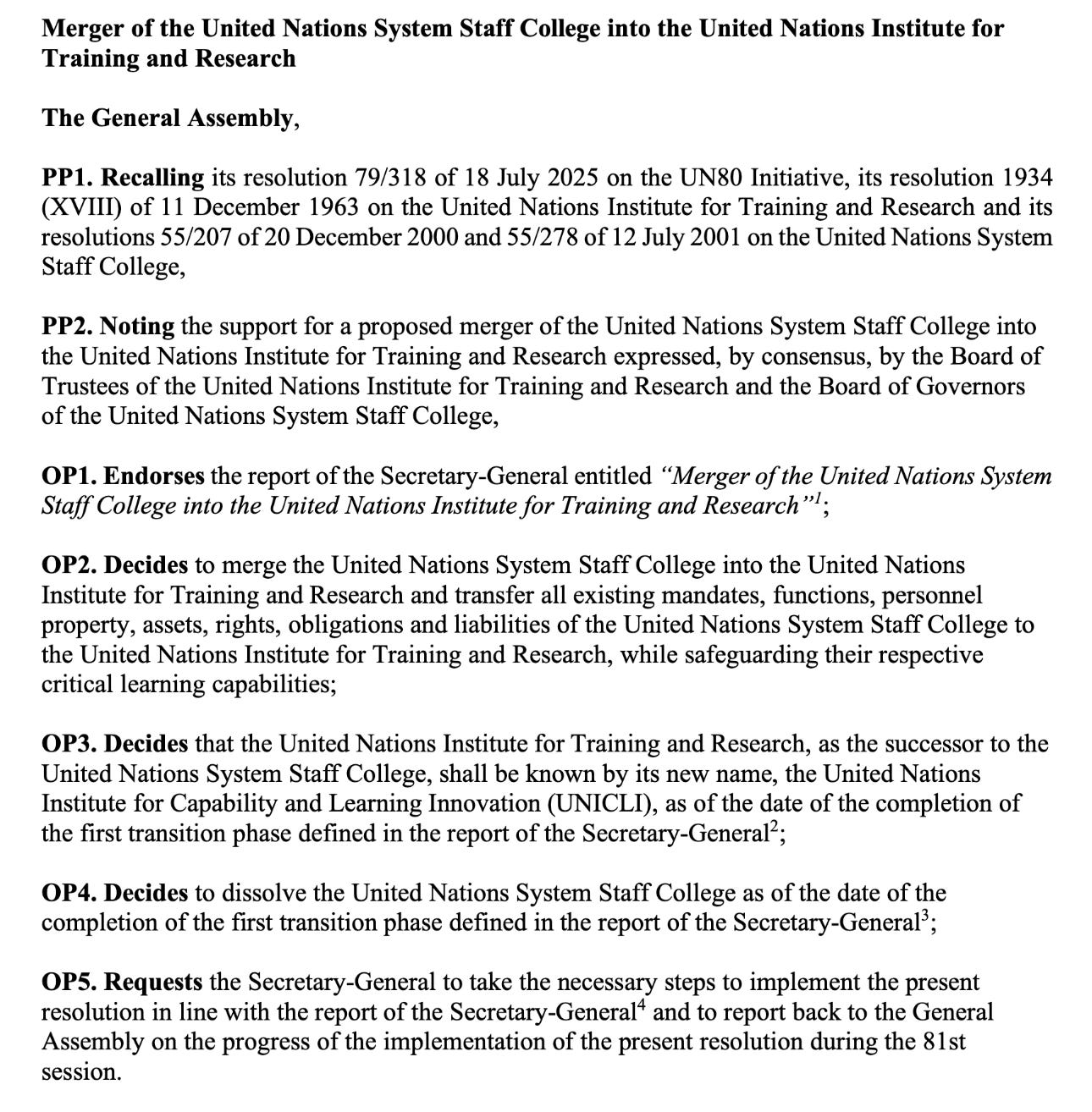
UN80: UNITAR & UNSSC merge as United Nations Institute for Capability and Learning Innovation (UNICLI)
President of the General Assembly (PGA) Annalena Baerbock communicated the outcome of Member States deliberations to merge the UN Institute for Training and Research (UNITAR) and the UN System Staff College (UNSSC), under Workstream 3 of the UN80 Initiative. The GA adopted the resolution (A/80/L.112) on 3 September 2026.
Barbados: sustainable development requires strengthened ECOSOC & HLPF
François Jackman, Permanent Representative of Barbados to the UN, spelled out the areas requiring strengthening and improvement for the UN’s sustainable development pillar of the recently completed Member State General Assembly reviews of HLPF and ECOSOC.
Speaking at a pre-HLPF webinar, he emphasized the importance of connections across diverse policy processes and primacy of and relevance to national development goals. The GA reviews addressed countries in different development and/or conflict situations, and the need to improve HLPF VNRs, especially the importance of higher quality data in their preparation, presentation and follow-up, and of engagement with the UN Resident Coordinator system. He also remarked that they had “a big discussion about the relationship between ECOSOC and the International Financial Institution…. I am hopeful we found language that will satisfy all parties”.
Addressing the 2030 Agenda and the SDGs and diverse positioning on post-2030, he said: “[W]e are in the pre-post-2030 discussion and countries, institutions are already beginning to think about what the post-2030 agenda could look like, while ensuring that we go as hard and far as we can with the SDGs that we have now. We are in an in-between place…. We want to hold on to do everything we can with what we have, while continuing to look forward to what we will need in the next phase.”
Algeria succeeds Nepal as new ECOSOC president
Amar Bendjama, Permanent Representative of Algeria, was elected as President of the Economic and Social Council (ECOSOC), succeeding Lok Bahadur Thapa, Permanent Representative of Nepal. The new bureau includes Ambassador Musayev, Permanent Representative of Azerbaijan, Ambassador Chowdhury, Permanent Representative of Bangladesh and Ambassador Vegas Torres, Chargé d’Affaires of Peru. See the incoming president’s priorities in his inaugural statement on 23 July.
VNRs as a national sustainable development tool beyond 2030
The 2027 SDG Summit will be an important moment for Member States, both to take stock of their progress on the Sustainable Development Goals (SDGs) and start discussions on the future beyond the 2030 Agenda. The Voluntary National Report (VNR) process can be a tool for the civil society to not only become involved in the stocktaking of SDG progress nationally but also a mechanism to monitor and hold to account on-going domestic efforts on the SDGs and sustainable development as a whole, by crosschecking national commitments with HLPF presentations and national statistical data.
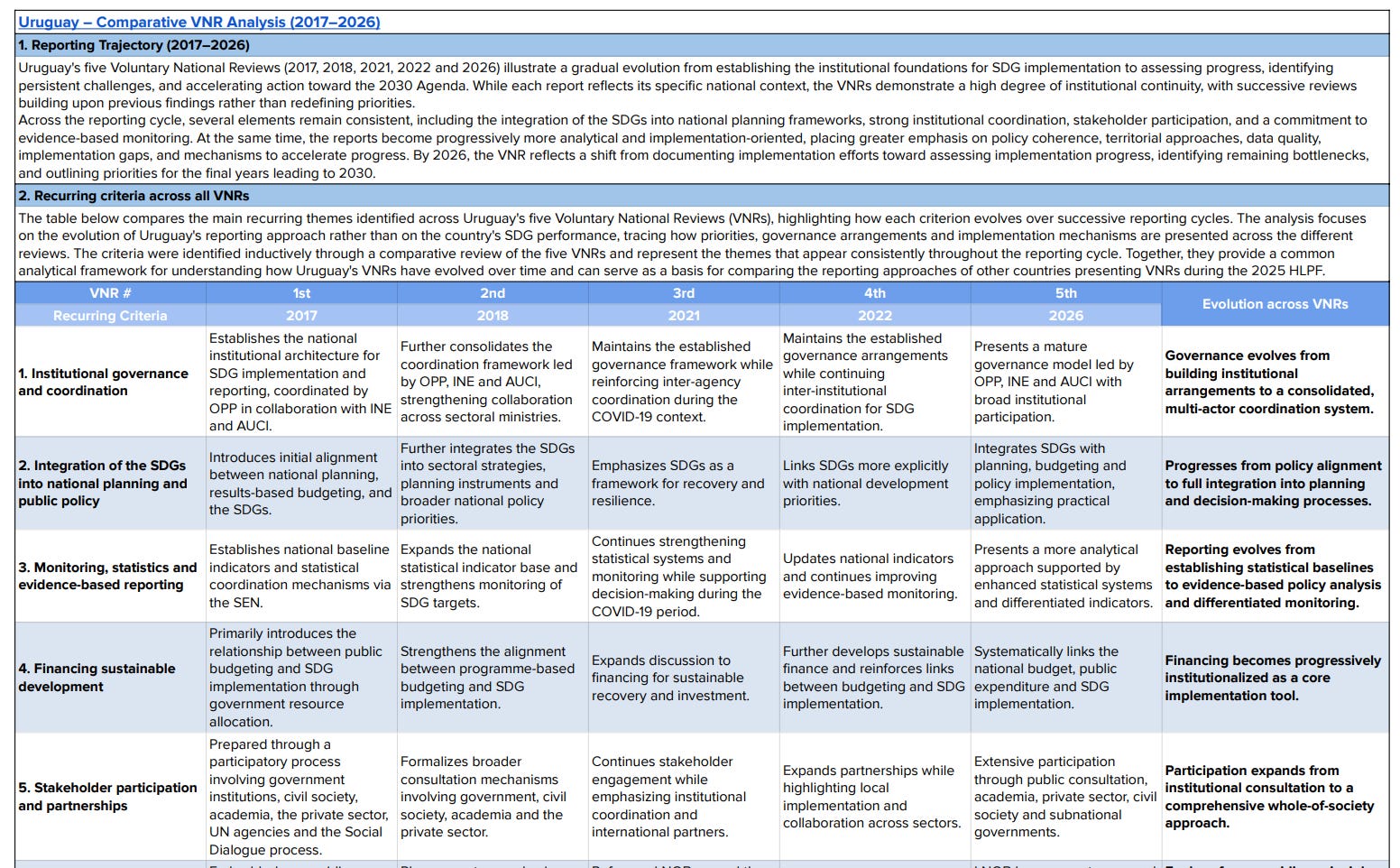
GPF has monitored the VNRs presented during the 2026 HLPF and prepared a comparison of a country’s available record of VNRs to track how reporting evolved over the years. See below excerpts of 2026 VNR presentations and here for GPF’s analysis of multi-year reports.
Uruguay: “[VNRs] contribute to organizing our priorities, improving the traceability between programmes and investments and strengthening the evaluation of our public policies. In other words, to go from just reporting progress to really guiding decisions…. Sustainable development is not built from the state. It requires listening, dialogue, evidence and co-responsibility between institutions, regions and society…. First, Uruguay must go from coverage to quality in terms of public services. Second, localizing Agenda 2030 is indispensable. We must disaggregate data, create multi-level governance and local capacities. Third, in order to accelerate results, the country must comprehensively manage several transitions in terms of demography, the climate, technology and energy, as well as development of the urban zones and production. Fourth, implementation requires data, institutional capacities, observatories and more robust evaluation systems. Five, partnerships and financing should be geared towards specific national and local priorities.”
Jamaica: “We reiterate the need for financial instruments calibrated more to vulnerability rather than income classification alone to help middle income countries exit the trap and achieve resilient, sustained growth. Within this context, Jamaica calls for the use of complementary measures of progress that go beyond GDP, including multidimensional vulnerabilities, in order to secure equitable access to affordable and concessional finance as we navigate an increasingly unpredictable global climate…. The post-2030 development agenda must, however, take lessons learned from this period and adopt clear means of implementation, manageable statistical frameworks and early inclusion into national planning systems.”
Latin America & the Caribbean Dialogue on Future UN Leadership
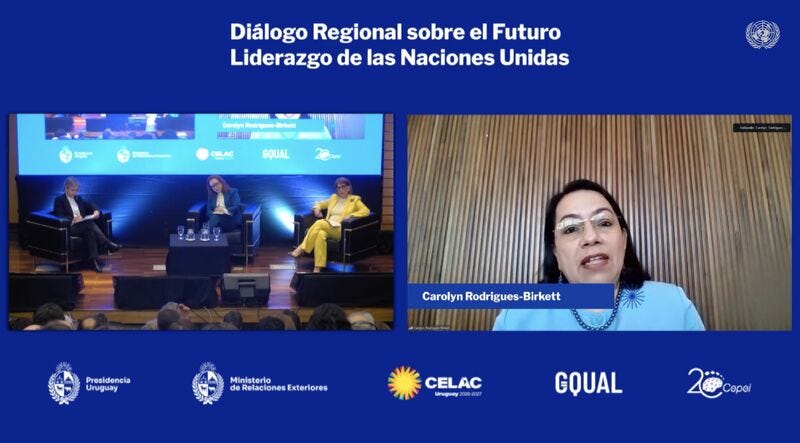
The term of UN Secretary-General António Guterres ends in 2026 and Member States are embroiled in the selection of his successor. President of the General Assembly Annalena Baerbock has hosted interactive dialogues with the candidates to make the process more transparent. The majority of candidates are from the Latin America and the Caribbean region in line with the practice of regional rotation. Uruguay took the initiative to host the first regional forum on 3 August 2026 and candidates from Latin America and the Caribbean laid out their vision of future UN leadership. They underscored the region’s shared history, identity and contribution to multilateralism, also elaborating individually their diverse styles of leadership rooted in their UN experience and expertise.
Grynspan approached issues from the perspective of development and institutional management; Grossi (online) emphasized executive leadership, diplomacy and crisis management; Espinosa focused on prevention, human rights and inclusive governance; Rodrigues-Birkett (online) highlighted consensus-building and the perspective of small states; Bachelet (video message) framed leadership around democratic values, human rights and ethical responsibility.
Common priorities from candidates included:
– Restoring confidence in multilateralism
– Defending the UN Charter and international law
– Strengthening preventive diplomacy
– Accelerating SDG implementation
– Reforming the international financial architecture
– Improving the effectiveness and credibility of the UN
– Addressing climate change through multilateral cooperation
– Increasing youth participation and advancing gender equality
– Giving developing countries a stronger voice in global governance
*Macky Sall (Senegal) did not join the dialogue. Two more candidates have since joined the UNSG race: Olara Otunnu (Uganda) & Ivonne A-Baki (Ecuador)
See also: Guyana ex-minister leads in 2nd straw poll for UN chief (AFP); previous straw poll results (via 1 for 8 billion); UN resources on the process, candidates and previous dialogues.
Open letter from academics for an International Panel on Inequality
Commissioned by the South African government as part of its G20 presidency and chaired by Joseph Stiglitz, the Extraordinary Committee on Inequality recommended establishing an International Panel on Inequality (IPI) at the UN to address the global inequality crisis. Like the Intergovernmental Panel on Climate Change (IPCC), the panel would bring together global academic work to develop a strong and clear consensus on the scale, drivers and consequences of the inequality crisis and potential policies to reduce it.
Governments of South Africa, Brazil, Spain and Norway, and the UN Secretary-General have shown support for the panel. Forty prominent academics have called on the UK government to join the campaign, urging Prime Minister Burnham to signal UK’s support at the upcoming UN General Assembly High-Level Week. Read the letter here.
Joint submission of 150+ CSOs on UN Tax Convention zero draft
The 5th round of negotiations on the UN Framework Convention on International Tax Cooperation took place 3-13 August at UNHQ. The process started in 2022 spurred by the initiative of the Africa Group, the negotiations continued to drafting Terms of Reference (TOR) in 2024 and formal negotiations are scheduled to continue until 2027.
Over 150 civil society organizations and trade unions made a joint submission in response to the release of the zero draft Framework Convention on tax and the two early protocols. Global Alliance for Tax Justice (GATJ) highlighted that while progress was made, the negotiations still lacked important elements, such as: ensuring equitable taxation of multinational enterprises; transparency provisions, including a global asset register, beneficial ownership registers and public country by country reporting; challenges related to environmentally damaging companies, including extractive industries; and the objective of reducing inequalities between and within countries, including through progressive taxation, among others.
See also: Civil Society FFD Mechanism monitoring of the Framework Convention & analysis and demands from Asian civil society organizations.
Call for input: Technologies related to climate change and their impacts on human rights
UN Special Rapporteur on climate change calls for inputs on issues related to human rights and climate change. The upcoming report focuses on actual and potential, positive and negative human rights impacts of climate-related technologies through a full life-cycle approach. Inputs are sourced from states, interested individuals, international organizations, independent researchers, non-governmental organizations, Indigenous Peoples, peasants, small-scale fishers, rural workers, and businesses.
Submission deadline: 30 September 2026
For more information: Technologies related to climate change and their impacts on human rights
Copyright (C) 2026 Global Policy Forum. All rights reserved.